

 listen
The text companion to this week's #rbnews international show is now online. You can read it after the jump.
 This work is licensed under a Creative Commons Attribution-NonCommercial-NoDerivs 3.0 Unported License.
Showing posts with label austerity. Show all posts
Showing posts with label austerity. Show all posts
Wednesday, 24 July 2013

Sunday, 14 July 2013
#rbnews weekly bulletin 06-12 July 2013
The text companion to this week's #rbnews international show is now online. You can read it after the jump.
Sunday, 30 June 2013
#rbnews weekly bulletin 22-28 June 2013
The text companion to this week's #rbnews international show is now online. You can read it after the jump.
Sunday, 23 June 2013
#rbnews weekly bulletin 15-21 June 2013
The text companion to this week's #rbnews international show is now online. You can read it after the jump.
Sunday, 9 June 2013
The Crisis turns a "blind eye" to military spending

High levels of military spending have played a significant role in the current European debt crisis and continue to diminish any chance of straightening things out.
This precise relationship between excessive militarization and the debt crisis, is being examined in a new report called "Weapons, Debt and Corruption: Military Expenditure and the Crisis of the EU" put together by think tank Transnational Institute.
This precise relationship between excessive militarization and the debt crisis, is being examined in a new report called "Weapons, Debt and Corruption: Military Expenditure and the Crisis of the EU" put together by think tank Transnational Institute.
During the past five years, there is an un-talked about "elephant" in Brussels. It involves expenses incurred for weapons whilst society is being reduced to shambles with wages and pensions continuously being slashed.
The arms industry continues to show profits from order placements when the total amount spent corresponds to 194 billion in 2010 - an amount equal to the deficits of Greece, Italy and Spain.
In the case of Greece, the country has analogically spent the highest amounts in Europe over the past four decades on such costs – at the same time the country has spent about twice its GDP compared to the EU average.
And whilst countries like Germany insist that harsher cuts must be made to social spending in order for states to repay their debts, they are not so emphatic when it comes to defense spending cuts. France and Germany have put pressure on the Greek government not to reduce such expenditure whilst at the same time France is closing a leasing deal with Greece for two of the most expensive European frigates.
According to reports, this move is more "a result of political will, than the initiative of the armed forces." As an adviser to former Prime Minister George Papandreou once said: "Nobody says' buy our vessels otherwise you will not be financially supported." It is obvious, however, that if we do, will seem more supportive. "
The arms industry continues to show profits from order placements when the total amount spent corresponds to 194 billion in 2010 - an amount equal to the deficits of Greece, Italy and Spain.
In the case of Greece, the country has analogically spent the highest amounts in Europe over the past four decades on such costs – at the same time the country has spent about twice its GDP compared to the EU average.
And whilst countries like Germany insist that harsher cuts must be made to social spending in order for states to repay their debts, they are not so emphatic when it comes to defense spending cuts. France and Germany have put pressure on the Greek government not to reduce such expenditure whilst at the same time France is closing a leasing deal with Greece for two of the most expensive European frigates.
According to reports, this move is more "a result of political will, than the initiative of the armed forces." As an adviser to former Prime Minister George Papandreou once said: "Nobody says' buy our vessels otherwise you will not be financially supported." It is obvious, however, that if we do, will seem more supportive. "
Sunday, 26 May 2013
Naomi Klein @ Radiobubble: Climate change is our best argument against free trade
Naomi Klein spoke today to Radiobubble's @JaquoUtopie about the economic and environmental crisis and how climate change affects economic and political transformation, but also about her upcoming work, gold mining and the movement opposing it in Skouries, the tar sands and the Idle No More movement in Canada.
The way that in a moment of economic desperation governments and corporations use the crisis as a pretext to destroy the environment by convincing people that this is the easier way to “get money”, the scare tactics, the lack of a clear and inspiring articulation of a radically different vision are some of the issues they discussed, as well as the cost that people will have to pay if capitalism continues down that destructive road.
But also about emerging peoples’ movements, the turning point in history when it’s time to create our own alternative, the failure of the media and the time for new models to develop and change the landscape, the hope, the future and her very young, beautiful son Tom.
You can listen to the interview above and/or read the transcript after the jump.
You can listen to the interview above and/or read the transcript after the jump.
Friday, 24 May 2013
UNICEF report: Rapid deterioration of living conditions in Greece

The National UNICEF Committee in Greece presented a new report titled: "The state of children in Greece in 2013," which was prepared in collaboration with the National and Kapodistrian University of Athens and describes the current living conditions of children in Greece, as well as a campaign and initiatives for vaccination of children in Greece and around the world.
The UNICEF report presents quite disturbing data concerning child poverty, living conditions, protection issues and delinquency among Greek and immigrant children in Greece. The report connects the rapid deterioration of the situation with the underlying financial crisis. The committee emphasizes that the crisis constitutes an inhibitory factor for the implementation of the International Convention on the Rights of the Child (CRC) and for this reason urges Greece not only to maintain social benefits but to expand them, especially for children. On the contrary, the policy that has been implemented these last few years with regard to the distribution of social protection expenditure in Greece shows that benefits for the family/children category remain almost constant. The indifference of the public sector has been steady over this period and it seems not to react even under these tough financial conditions. Firstly, in terms of social protection expenditure in Greece, family/children benefits remained unchanged over the past 15 years. Secondly, the way in which the budget is established and implemented does not allow for identification of resources allocated for the implementation of the CRC, nor does the lack of systematic and specific data allow for monitoring compliance with it.
Saturday, 18 May 2013
#rbnews weekly bulletin 11-17 May 2013
The text companion to this week's #rbnews international show is now online. You can read it after the jump.
Tuesday, 14 May 2013
Update on the teachers' strike and civil mobilization - 14 May 2013
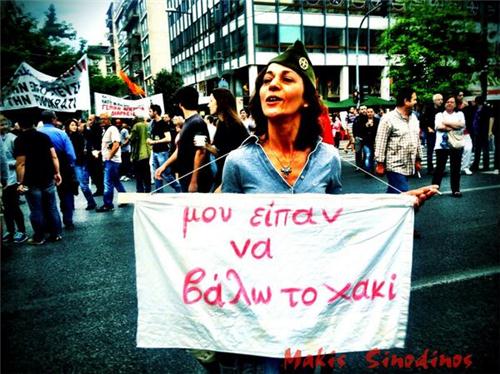 |
| "They told me to wear the uniform" A teacher protests in front of parliament on 13 May in Syntagma square Picture by @MakisSinodinos |
Greek secondary education teachers, together with various groups who joined them in solidarity, held a demonstration yesterday in front of parliament to protest the government's decision to issue preemptively a civil mobilization order for 86,000 teachers in order to prevent a possible strike on the first day of the national university entry exams, as proposed by the Federation of Secondary Education Teachers (OLME). The Council of State, Greece's highest administrative court, rejected yesterday a request by OLME for temporary suspension of the civil mobilization order, despite the dubious legality and constitutionality of back-to-work legislation issued before a formal decision to go on strike is officially approved by regional unions.
Teachers are the third professional group, after employees of the Athens metro and sailors, to be hit by a civil mobilization order since the current coalition government was elected to power. Trucking contractors and municipal workers's strikes were also broken in this way in 2010 and 2011. Of a total of 11 civil mobilization orders issued in Greece since the fall of the Junta, 5 were issued in the framework of bailout austerity policies.
Monday, 13 May 2013
Guest post: The Greek government denies secondary education teachers the right to strike
By Panagiotis Sotiris [1]
In the past three years Greek society has gone through a series of extremely aggressive austerity measures, under the terms dictated by the EU-IMF-ECB Troika that have led to a severe deterioration of living conditions. It has also been experiencing a constant erosion of democratic rights and basic civil liberties. Part of it is the attempt by the Greek government to practically abolish the right to strike in many sectors. Government representatives have repeatedly insisted that it is time to get rid of the “anomic” forms of protest and struggle that have been the main legacy of post-1974 radicalism.
The latest such example is the decision of A. Samaras, the Greek Prime Minister, to issue “civil mobilization” orders for all secondary education teachers, because OLME, the Secondary Education Teachers Confederation, has announced that it proposes to its member unions to stage a strike during the University Entry Exams beginning May 17. The order issued by the Prime Minister includes references to a potential “important disruption of the social and economic life of the country” and to “grave dangers for public order and the health of candidates taking the university entry exams”, and was issued as a preemptive measure before the strike is even decided by the local secondary education unions on Tuesday May 14.
Thursday, 9 May 2013
Alex the lazy Greek
By @galaxyarchis, translated by @IrateGreek
The Omikron Project team, who seek to break, through video spots and ads, the various European stereotypes about Greeks and Greece in the context of the financial crisis, completed their second cartoon. The video's protagonist is Alex, a Greek worker whom many international media describe as lazy, and who therefore is perceived as deserving the punishment of austerity imposed upon him by the European Union.
The Omikron Project team, who seek to break, through video spots and ads, the various European stereotypes about Greeks and Greece in the context of the financial crisis, completed their second cartoon. The video's protagonist is Alex, a Greek worker whom many international media describe as lazy, and who therefore is perceived as deserving the punishment of austerity imposed upon him by the European Union.
You can activate subtitles in multiple languages in the video above.
Wednesday, 8 May 2013
6 May 2012 - 6 May 2013: one year from the Greek general elections of May 2012
By @galaxyarchis, translated from Greek by @anarresti, corrections by @IrateGreek
Greece recently had two very important political anniversaries. More specifically, May 6th, 2013, marked three years since the adoption of the Memorandum which caused the greatest political rearrangements in the country's recent history, and one year since the 2012 general elections, when those dramatic changes were first expressed through the ballot box. Greek society is living in a period where political time is condensed to such a degree, that the changes occurring every month and every week can hardly be conceived by its collective consciousness. Since the May 2012 elections, which did not lead to the formation of a new government but to repeat elections a month later, the country's image and its political landscape kept changing at a rapid pace until today. In light of a greater tribute to the one year anniversary since last June's elections, when today's three-party coalition government came to power, we take a look at the facts and data which changed in this past year, starting from last May's elections.
 |
| By Spyros Derveniotis Translation: "Dirty immigrants, dying where the Greeks eat! |
Saturday, 4 May 2013
Freedom of the press in Greece: an interview with Leon Willems
The following post is a transcript of this interview with Leon Willems, the director of Free Press Unlimited. It was translated by @iptamenos33.
- Mister Willems, good morning!
- Good morning?
- In which European holiday-countries are journalists facing difficulties?
- Ah, well, it's very interesting to see that in a couple of Southern European countries, things are getting worse constantly, for instance in Greece.
- Mister Willems, good morning!
- Good morning?
- In which European holiday-countries are journalists facing difficulties?
- Ah, well, it's very interesting to see that in a couple of Southern European countries, things are getting worse constantly, for instance in Greece.
Friday, 3 May 2013
OKANA running low on methadone amid lack of funds
The Greek Organisation Against Drugs (OKANA) faces the risk of running out of methadone, due to delays in deliveries by the Institute of Pharmaceutical Research & Technology (IFET). According to news website tvxs.gr the medicine's reserves can hardly last for a week. However even a 10-day supply delay could have a severe knock-on effect on patients receiving substance abuse treatment.
OKANA chief, Meni Malliori confirmed that extra orders of methadone should be delivered after May 20, but there will be efforts to secure an emergency supply to cover one month's needs.
@inflammatory_
OKANA chief, Meni Malliori confirmed that extra orders of methadone should be delivered after May 20, but there will be efforts to secure an emergency supply to cover one month's needs.
@inflammatory_
Monday, 8 April 2013
Informativo semanal desde Grecia #26 - 6 abril 2013
Redactado por el equipo de #rbnews internacional, traducido por @mpatman
En las noticias de rbnews international de esta semana:
- Reacciones en curso en contra de la explotación de minas de oro en el norte de Grecia, mientras que un estudio revela una contaminación generalizada del agua por metales pesados publicada en el diario de los redactores.
- Manifestaciones sobre el proceso de obtención de la nacionalidad griega para la segunda generación de hijos de inmigrantes que realizaron organizaciones antirracistas en varias ciudades del país.
- El ayuntamiento de Atenas amenaza con cerrar una docena de sitios basándose en una ley de la dictadura griega del siglo pasado.
- Se mantiene por tercer año consecutivo la imposición, a través de las facturas de electricidad, de un impuesto sobre los inmuebles a pesar de las fuertes reacciones sociales.
- Continúa la operación Tetis de la policía griega contra los drogodependientes en el centro de Atenas.
Wednesday, 20 February 2013
General strike in Greece 20 February 2013 - Summary and photo gallery
A general strike took place in Greece today 20 February 2013. It was called by the three main labour unions, GSEE (General Confederation of Workers), ADEDY (the umbrella union of civil servants) and PAME (the union affiliated with the Communist Party of Greece), and was followed by a large variety of professions from the public and private sector, including, among others, lawyers, tax collectors, engineers, doctors, builders, private sector employees, municipal workers, bank employees, teachers and dock workers. The strike was intended to protest austerity policies in general, and in particular measures pertaining to labour such as the abolition of collective labour agreements and the enforcement of civil mobilisation orders against striking workers.
Sunday, 10 February 2013
#rbnews international weekly bulletin 02-08 February 2013
The text companion to this week's #rbnews international show is now online. You can read it after the jump.
Thursday, 31 January 2013
Movilizaciones de la semana en Grecia
Tras la civilización forzosa del gobierno a los trabajadores huelguistas del metro de Atenas la semana pasada, el domingo, 27 de enero el tribunal decidió como ilegal la huelga del sindicato de los conductores de autobuses y trolebuses. La tarde del mismo día, los trabajadores hicieron una asamblea de emergencia. Finalmente, los trabajadores de los autobuses y trolebuses después de su asamblea decidieron a continuar su huelga a pesar que fue ilegal por el tribunal, hasta el 29 de enero cuando se realizó una nueva asamblea para decidir si van a continuar la movilización. En la asamblea se decidió la inhibición de la huelga y una nueva huelga de 24 horas para el 31 de enero.
Mientras tanto, los trabajadores de autobuses y trolebuses sostienen que la decisión del tribunal fue decidida sin su presencia, ya que les llamaron por la noche. Además, el Consejo de Estado ha rechazado la demanda de los trabajadores de Metro de Atenas para anular la decisión de la movilización forzosa. Su apoyo a las protestas de los trabajadores del Metro de Atenas anunció el sindicato de trabajadores del transporte público en Amsterdam, citando que es una "lucha común".
El lunes por la mañana comenzaron también las manifestaciones de los agricultores, demandando entre otras cosas la reducción del precio del petroleo y de la electricidad, creditos sin intereses hasta que acaba la crisis para los pobres agricultores y no más reducciones a las pensiones bajas de ellos. También bloquearon por unos minutos la autopista a la altura de Larissa con tractores. El martes, 29 de enero los agricultores fueron a Atenas para hablar con los políticos del gobierno y de la oposición.
Sunday, 23 December 2012
Informativo semanal desde Grecia #11 - 22 Diciembre 2012
1. 21 muertos, 6 desaparecidos y un superviviente es el relato del naufragio de una embarcación que transportaba inmigrantes sin papeles a Mitilini, en el noreste del Egeo, el sábado 15 de Diciembre. Los inmigrantes procedían de Afganistán; entre ellos había niños y bebés, y el superviviente es menor de edad. Esta es una de las muchas tragedias que se producen con frecuencia en el Egeo. De hecho, los flujos migratorios por vía marítima han incrementado en los últimos meses como posible consecuencia de una intensificación en los controles por la frontera terrestre con Turquía . Al mismo tiempo, se completó la construcción de la valla en Evros, en la frontera con Turquía, que tiene por objeto impedir la entrada de inmigrantes y cuyo coste de construcción ha alcanzado los 3.160.000 euros.
Sunday, 25 November 2012
Informativo semanal desde Grecia #7 - 24 Noviembre 2012
1. El Domingo 18 de Noviembre tuvo lugar otra manifestación en Jalkidikí, al norte de Grecia, en contra de un proyecto para la creación de una mina de oro que se cree que causará un desastre ambiental. El proyecto está liderado por el famoso empresario Griego, Bobolas, y la empresa Canadiense Eldorado Gold. Si el proyecto sigue adelante, se generará una masiva deforestación y una contaminación irreversible de los acuíferos locales. Durante la concentración de los manifestantes, hubo cierta tensión entre los que apoyan el proyecto y los que están en contra. La manifestación en contra del proyecto fue masiva ya que contó con la participación de 3.000 personas. A diferencia de otras manifestaciones anteriores, esta vez los manifestantes han optado por no tratar de llegar al campo de trabajo, lo que hubiera generado enfrentamientos violentos teniendo en cuenta que diecisiete divisiones de antidisturbios fueron desplegadas en el bosque. Al final se quedaron alrededor del pueblo en el cual se concentraron.
Subscribe to:
Posts (Atom)