Creative Commons License This work is licensed under a Creative Commons Attribution-NonCommercial-NoDerivs 3.0 Unported License.
Showing posts with label bailout. Show all posts

Sunday, 9 June 2013

The Crisis turns a "blind eye" to military spending

By @csyllas, translated by @EliVou

Click to enlarge
High levels of military spending have played a significant role in the current European debt crisis and continue to diminish any chance of straightening things out.

This precise relationship between excessive militarization and the debt crisis, is being examined in a new report called "Weapons, Debt and Corruption: Military Expenditure and the Crisis of the EU" put together by think tank Transnational Institute.

During the past five years, there is an un-talked about "elephant" in Brussels. It involves expenses incurred for weapons whilst society is being reduced to shambles with wages and pensions continuously being slashed.

The arms industry continues to show profits from order placements when the total amount spent corresponds to 194 billion in 2010 - an amount equal to the deficits of Greece, Italy and Spain. 

In the case of Greece, the country has analogically spent the highest amounts in Europe over the past four decades on such costs – at the same time the country has spent about twice its GDP compared to the EU average. 

And whilst countries like Germany insist that harsher cuts must be made to social spending in order for states to repay their debts, they are not so emphatic when it comes to defense spending cuts. France and Germany have put pressure on the Greek government not to reduce such expenditure whilst at the same time France is closing a leasing deal with Greece for two of the most expensive European frigates.

According to reports, this move is more "a result of political will, than the initiative of the armed forces." As an adviser to former Prime Minister George Papandreou once said: "Nobody says' buy our vessels otherwise you will not be financially supported." It is obvious, however, that if we do, will seem more supportive. "

Friday, 24 May 2013

UNICEF report: Rapid deterioration of living conditions in Greece

By @galaxyarchis, translated from Greek by @catalternative, edited by @pexlibanis

The  National UNICEF Committee in Greece presented a new report titled: "The state of children in Greece in 2013," which was prepared in collaboration with the National and Kapodistrian University of Athens and describes the current living conditions of children in Greece, as well as a campaign and initiatives for vaccination of children in Greece and around the world. 

The  UNICEF report presents quite disturbing data concerning  child poverty, living conditions, protection issues and delinquency among Greek and immigrant children in Greece. The report connects the rapid deterioration of the situation with the underlying financial  crisis. The committee emphasizes that the crisis constitutes an inhibitory factor for the implementation of the International Convention on the Rights of the Child (CRC) and for this reason urges Greece not only to  maintain social benefits but to expand them, especially for children. On the contrary, the policy that has been implemented these last  few years with regard to the distribution of social protection expenditure in Greece shows that benefits for the family/children category remain almost constant. The indifference of the public sector has been steady over this period and it seems not to react even under these tough financial conditions. Firstly, in terms of social protection expenditure in Greece, family/children benefits remained unchanged over the past 15 years. Secondly, the way in which the budget is established and implemented does not allow for identification of resources allocated for the implementation of the CRC, nor does the lack of systematic and specific data allow for monitoring compliance with it. 

Tuesday, 14 May 2013

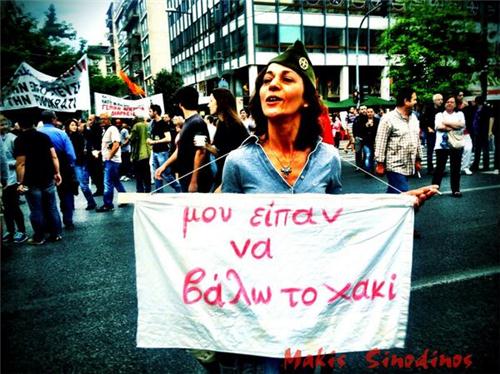
Update on the teachers' strike and civil mobilization - 14 May 2013


"They told me to wear the uniform"
A teacher protests in front of parliament on 13 May in Syntagma square
Picture by @MakisSinodinos
By @IrateGreek 

Greek secondary education teachers, together with various groups who joined them in solidarity, held a demonstration yesterday in front of parliament to protest the government's decision to issue preemptively a civil mobilization order for 86,000 teachers in order to prevent a possible strike on the first day of the national university entry exams, as proposed by the Federation of Secondary Education Teachers (OLME). The Council of State, Greece's highest administrative court, rejected yesterday a request by OLME for temporary suspension of the civil mobilization order, despite the dubious legality and constitutionality of back-to-work legislation issued before a formal decision to go on strike is officially approved by regional unions.

Teachers are the third professional group, after employees of the Athens metro and sailors, to be hit by a civil mobilization order since the current coalition government was elected to power. Trucking contractors and municipal workers's strikes were also broken in this way in 2010 and 2011. Of a total of 11 civil mobilization orders issued in Greece since the fall of the Junta, 5 were issued in the framework of bailout austerity policies.

Monday, 13 May 2013

Guest post: The Greek government denies secondary education teachers the right to strike

By Panagiotis Sotiris [1]


In the past three years Greek society has gone through a series of extremely aggressive austerity measures, under the terms dictated by the EU-IMF-ECB Troika that have led to a severe deterioration of living conditions. It has also been experiencing a constant erosion of democratic rights and basic civil liberties. Part of it is the attempt by the Greek government to practically abolish the right to strike in many sectors. Government representatives have repeatedly insisted that it is time to get rid of the “anomic” forms of protest and struggle that have been the main legacy of post-1974 radicalism.

The latest such example is the decision of A. Samaras, the Greek Prime Minister, to issue “civil mobilization” orders for all secondary education teachers, because OLME, the Secondary Education Teachers Confederation, has announced that it proposes to its member unions to stage a strike during the University Entry Exams beginning May 17. The order issued by the Prime Minister includes references to a potential “important disruption of the social and economic life of the country” and to “grave dangers for public order and the health of candidates taking the university entry exams”, and was issued as a preemptive measure before the strike is even decided by the local secondary education unions on Tuesday May 14.

Wednesday, 8 May 2013

6 May 2012 - 6 May 2013: one year from the Greek general elections of May 2012

By @galaxyarchis, translated from Greek by @anarresti, corrections by @IrateGreek


By Spyros Derveniotis
Translation: "Dirty immigrants, dying
where the Greeks eat!
Greece recently had two very important political anniversaries. More specifically, May 6th, 2013, marked three years since the adoption of the Memorandum which caused the greatest political rearrangements in the country's recent history, and one year since the 2012 general elections, when those dramatic changes were first expressed through the ballot box. Greek society is living in a period where political time is condensed to such a degree, that the changes occurring every month and every week can hardly be conceived by its collective consciousness. Since the May 2012 elections, which did not lead to the formation of a new government but to repeat elections a month later, the country's image and its political landscape kept changing at a rapid pace until today. In light of a greater tribute to the one year anniversary since last June's elections, when today's three-party coalition government came to power, we take a look at the facts and data which changed in this past year, starting from last May's elections.

Saturday, 23 March 2013

#rbnews international show 23 March 2013: Greece and Cyprus, a tale of two crises

On 23 March 2013 on #rbnews international, we discussed how Greeks and Cypriot perceive each other and their countries in the context of the sudden, acute financial crisis that engulfed Cyprus since last week. Our guests (via Skype) were George Markides (@georgiemark) and George Iordanou (@iordanou) from Cyprus, Nick Malkoutzis (@NickMalkoutzis) from Greece, and Yiannis Mouzakis (@YiannisMouzakis), who is a little bit from both.

Special thanks to @pitsirikos, @CorinaVasilopoulou, @adiasistos, @madamitsa@giwrgoslouvaris@MariaCuchicheo@ZenonZindilis, @Kartesios, @atreyiou and @SovJohn whose tweets gave us food for thought for this show.

You can listen to the podcast, as usual, after the jump.

Sunday, 18 November 2012

#rbnews international show 17 November 2012

By @IrateGreek

On the #rbnews international show on 17 November 2012, our guest was Joanna Kakissis, journalist with National Public Radio and Time magazine. We discussed the commemoration of the 1973 Polytechnic University uprising, the delay in the disbursement of Greece's latest tranche of bailout loans, and the independence (or not) of the Greek judiciary. You can follow Joanna on Twitter @joannakakissis

In tribute to the 1973 Polytechnic uprising but also to celebrate World Tolerance Day on 16 November, we played songs from "Our Great Circus", an anti-Junta musical first performed in Athens in the summer of 1973. The promotion of World Tolerance Day is supported by the 1 Against Racism network.

You can listen to the podcast and download the weekly news bulletin in English after the jump.

Wednesday, 7 November 2012

What happened in the morning of #7ngr in the Greek Parliament

by @doleross

When discussions over the draft law on the new austerity measures (Memorandum III) started in the Greek Parliament this morning, Syriza and Independent Greeks questioned the compatibility of thedraft law with the Constitution. According to the rapporteurs of the two parties, paragraphs on salary and pension cuts were unconstitutional, and so was the way the draft law came to discussion in Parliament: that is the emergency procedure which limits discussion time to 10 hours, even though many members of the Parliament only received the final, very long text of the law, on the same morning.

Tuesday, 12 June 2012

Was the bailout of Greece legal?


Edited by Keith Ewing, Professor of Public Law at King’s College London, for USI
As the European political crisis becomes ever more intense and the economic crisis ever more acute, there is a third crisis yet to unfold.  This is the crisis of legality now engulfing the EU, an entity that seems to be free to do what it likes and to ignore the legal foundations on which it is supposed to be built.
The EU, its institutions and its representatives are required to act with legal authority and within the scope of legal powers.   To this end, the post–Lisbon treaty is full of clearly expressed principles and obligations, the EU apparently founded on the values of ‘human dignity, freedom, democracy, equality, the rule of law and respect for human rights’.

Monday, 21 May 2012

Reflections on Greece: a social crisis

Edited by Andrew Brady for USi
USi spent six nights in Athens recently to gather momentum for our ‘Solidarity with Greece’ campaign with trade unions and community networks. This article is one of three on our reflections on the challenges facing the City and Greece – and what as trade unionists we must do to assist.
With Greece’s future increasingly in doubt an emergency government was established on Wednesday (16 May) with new elections set for 17 June. Away from the debates swirling around about GDP debt ratios, sovereign debt, and, bond rates something very profound and alarming is happening on the ground.

Unemployment, suicides, prostitution, drug abuse, depression, homelessness and hopelessness are sky-rocketing. You can see the visible impact of the economic crisis when you walk around areas of the City such as Omonoia and Agios Panteleemonas. It is not easy to witness or take in.
Greece’s jobless rate hit a new record in February. Data from Greece’s statistics service on Thursday (17 May) showed unemployment hit 21.7 percent in February. In the 15-24 age group it rose to 54 percent. The data showed nearly 1.1 million people were jobless, 42 percent more than in the same month a year ago, reflecting the huge scale of the human damage. However, the true scale of unemployment and underemployment is higher. The country’s economy continues to contract for a fifth consecutive year.
The New York Times reported in April that in Greece, the suicide rate among men increased more than 24 percent from 2007 to 2009, government statistics show. The suicide rate increased by 40 percent in the first half of 2011. Greece’s financial crisis has also made some families so desperate they are giving up the most precious thing of all – their children – as they can’t take care of them any longer. There are estimates that up to 20,000 people are homeless in Athens.
Prostitution is legal in Greece, with regular health checks for sex workers required, but authorities say only a fraction of brothels are operating with a license. According to the disease control center, 954 new HIV infections were reported in 2011, a 57 percent increase from the previous year. The authorities say they are concerned about the overlap between drug use and illegal prostitution. The Athens City government has said at least 315 brothels are currently operating illegally in the Greek capital. Greece is also the busiest transit point for illegal immigration in the European Union – and for human traffickers bringing women from Eastern European countries.
In conversation after conversation USi was told of the network of grandparents who are holding Greek society together with their pensions and support but this entitlement is continuously under attack to the point of being eroded. Wages have been decimated as you can read elsewhere on our site. People openly speak about moving out their homes (owned or rented) to move back in with family or friends as they can’t afford to pay the costs of living. Solidarity networks have sprung up all over Athens such as the Network for Cheap Potatoes and Convenience Stores to help alleviate the pressure and pain. But people and communities are hanging by a thread.
Society is approaching a critical point. This is the story the vested interests who pursue austerity do not want you to read or hear.  They would rather it remains focused on the perpetuation of myths such as ‘lazy Greeks’ in order to carry through privatisation and liberalisation of the whole state for profit. The human damage is irrelevant or at best secondary to private sector investors being reimbursed for ill-judged financial decisions and the subsequent exposure they bear on other European markets. As has been illustrated elsewhere – particularly by Yanis Varoufakis – the economics of Greece is minor to the financial tsunami that threatens to implode across Europe – and the people of Greece are way down the pecking order.
The imposed conditions of the second bailout will be enforced in June including tens of thousands of job losses and further pay cuts. Those fortunate to still have a job are of course extremely worried about their futures. On the day the agreement was reached in February this year Former French President Nicolas Sarkozy said: “Today the problem is solved”. To the contrary, unless resistance to austerity continues and increases – the problem may be only beginning.

Saturday, 19 May 2012

Greek elections: the politics behind failure and the challenges ahead of success

By @inflammatory_ 

There was media frenzy over fruitless coalition talks and the "last-ditch efforts" to form the so-called "government of prominent personalities". Following Papademos leadership, the option of having unelected technocrats in government again, was under consideration. With the tyranny of pragmatism enslaving politics and society, fully trained economists are seen more competent to spot the right policies. They are supposed to have the skills and experience to ensure successful execution of EU guidelines and maintain effectiveness in a financial environment of ambiguity. Is there any clear evidence to support that? The euro for instance, was launched without significant political institutions behind it, which was not proved to be very clever. However the prospect of a second round of elections, was expected to bring havoc anyway. Under edgy circumstances,  voting -the backbone of democracy- is considered lethal. No need to wonder which section of society might feel threatened when people have their say for their own matters. Apparently a caretaker prime minister took over until elections in June, with a possible "Grexit" making headlines at the moment.

Monday, 7 May 2012

The day after elections: all the latest developments


By @inflammatory_


With more than two years of cuts, layoffs, unemployment and…suicides’ rising toll, Greeks expressed their resentment over the political establishment yesterday, in what appeared to be one of the most low-key general elections.  There were no massive rallies, not excessive use of promotional material whilst for the first time, socialist PASOK and conservative New Democracy avoided setting up in public space their pre-election campaign kiosks, in case passersby attempt to destroy them.

From the beginning, it appeared unlikely for any political party to win a majority. Some believe that the election results officially dropped the final curtain on polity, the time period from 1974 onward, where PASOK and New Democracy succeeded each other in power. With many voters backing small parties and left-wing Syriza achieving its best result ever with sweeping gains in constituencies that traditionally belonged to rivals, there is a merit on that assumption.

Friday, 16 March 2012

Discussion of the bailout in Parliament on 11 February 2012

By @IrateGreek

The second bailout agreement between Greece and its international lenders was discussed in the Financial Affairs Committee of parliament on 11 February, one day before it was voted upon in the plenary session of parliament. Below is the intervention of E.Panaritis, MP for the governing party PASOK, during the discussion. Mrs Panaritis voted in favour of all provisions of the bill.

Note: If subtitles do not appear automatically, please go to YouTube view and click on the CC button at the bottom right of the video.


Saturday, 10 March 2012

Greece: the morning after PSI in international media

By @IrateGreek

Wall Street Journal
Greece defaults, and Tries to Move On, by Charles Forelle

"The biggest immediate benefit to Greece is that its problems are put off until another day. It has a €14.5 billion bond due March 20, and it doesn't have money to pay it. That bond in its entirety has been forced into the swap, and Greece's first principal payment on it will now be in 2023."

Guardian
Greek deal is not the end of the story by any means, by Larry Elliot
"This, then, was a triumph for Greece but only in the way that Dunkirk was for Britain."

Sunday, 12 February 2012

LIVE BLOG on anti-austerity protests: Feb 10-11 & 12

By @inflammatory_ 

FEB 12 TIMELINE

01:00 Recap of the day's main events 

"Greece en rage", might be an accurate description of what happened today.

  • Several preventive detentions in Athens took place before even the demo starts. 
  • Massive turnout as expected.The crowd was dispersed very early though, around 17:30-18:00 when tensions aroused on the front side of the demo and riot police officers started hurling teargas to repel demonstrators on the lower side of the square.
  • The demo was split, but protesters remained en masse in the nearby roads, to avoid clouds of tear gas filling the air...which was literally unbearable. With sheer determination they attempted to get back on the spot but riot squad tactics were aimed at halting the demo. This cat-and-mouse chase kept for 3,5 hours.
  • There were reports by journalists of policemen attacking on random people, protesting peacefully.
  • Paul Mason, the BBC correspondent was attacked by a bunch of far right protesters as they thought he was German. The worst was prevented thanks to other people's intervention.
  • Clashes spread across the city, with banks and retail outlets set on fire. Estimated number of arsoned buildings at 10  45.
  • 100 people suffered injuries, while 74 have been arrested and 92 detained.
  • In Thessaloniki 28.000 people demonstrated (including PAME members) and clashes broke out between protesters and riot police as well.
  • pic.twitter.com/ooyVsM7e
    Feb 12, 2012 Demonstrators flooding the streets outside the parliament before clashes pic @Jaquou Utopie

Tuesday, 1 November 2011

Referendum conduct & what applies to the electorate

By @doleross, translated from Greek by @inflammatory_

Greece's Prime Minister George Papandreou, announced that his country will hold a referendum on the new EU aid package, sparking fierce debate on both its aims and constitutional context. Some facts about the referendum are following below.