

 listen
The text companion to this week's #rbnews international show is now online. You can read it after the jump.
 This work is licensed under a Creative Commons Attribution-NonCommercial-NoDerivs 3.0 Unported License.
Showing posts with label national broadcaster. Show all posts
Showing posts with label national broadcaster. Show all posts
Wednesday, 24 July 2013

Sunday, 14 July 2013
#rbnews weekly bulletin 06-12 July 2013
The text companion to this week's #rbnews international show is now online. You can read it after the jump.
Tuesday, 9 July 2013
#rbnews weekly show 06 July 2013 - The failure(s) of democracy in Greece
This week on the #rbnews international show, we asked lawyer Crystali Bourcha from the Movement for the Liberties and Democratic Rights of our Times (Greek acronym KEDDE) and journalist Mariniki Alevizopoulou from Unfollow Magazine to comment on the items that we included in our news bulletin of the week, which all seem to point towards the failure of democracy in Greece.
You can listen to the podcast and read the news bulletin after the jump.
The interviews were taken by phone. We apologize for the poor quality of the sound, especially in the case of our interview with Crystali Bourcha. For some unexplainable reason, the recording device was particularly intent to add parasites to her speech.
You can listen to the podcast and read the news bulletin after the jump.
The interviews were taken by phone. We apologize for the poor quality of the sound, especially in the case of our interview with Crystali Bourcha. For some unexplainable reason, the recording device was particularly intent to add parasites to her speech.
Sunday, 30 June 2013
#rbnews weekly bulletin 22-28 June 2013
The text companion to this week's #rbnews international show is now online. You can read it after the jump.
#rbnews international show 29 June 2013: Culture in the time of the crisis, part 4 - The ERT musical ensembles
The show is based on interviews with conductor Michalis Economou (Qatar Philharmonic Orchestra, Athens Municipality Orchestra, guest conductor at the ERT symphony orchestra), contrabassist Theo Lazarou (ERT symphony orchestra) and tenor Loukas Panourgias (ERT chorus).
The pieces of music included in this podcast (Elgar's Nimrod, Beethoven's Fifth Symphony, Verdi's Dies Irae, and the overture of Mozart's Magic Flute) were performed during the solidarity concert organized at ERT on 14 June 2013, with participation from all the major orchestras of the greater Athens area. You can watch a partial video of this concert here.
And of course, you can listen to the podcast, as usual, after the jump.
Monday, 24 June 2013
Guest post - Greece: the battle for ERT and the difficult but necessary path from protest to political change

After the June 2012 election in Greece one of the main preoccupations of both the Greek government and the Troika (EU-IMF-ECB) representatives was to present an image of a strong government that would stand firm and would not succumb the pressure coming from a society in despair. For some time this tactic seemed to work, aided by the inability of mass protests to produce concrete positive results and the choice of the SYRIZA leadership to opt for a “ripe fruit” strategy regarding governmental power. However the ongoing struggle over the fate of Greek Public Television and Radio (ERT) has put an end to this fantasy of a strong government in a position to smoothly pass socially devastating legislation.
In the struggle for ERT, for the first time we have had a mass movement that led to a significant political rupture. The combination of a defiant stance from ERT employees who decided to occupy the premises and continue broadcasting, even in the form of web TV, creating a tangible example of the quality of public service that self-management can bring, with a broader social and political mobilization in support of ERT and in opposition to the authoritarian turn of the Samaras government that led to the mass presence outside ERT headquarters and local stations, intensified a deeper governmental crisis that had its roots in the social and economic crisis and the inability for the Greek government to offer an exit from the vicious circle of recession, austerity and unemployment. Contrary to the prevailing myth, even within the forces of the Left, that people are disappointed and that it would be difficult to urge them to go back in the streets, the struggle over ERT brought forward the potential for solidarity, mass mobilization and support of an important struggle. The struggle over ERT became the metonymy for all forms of aggression against not only social rights, but also against democracy per se. The black screens became the symbol of the aggressive, undemocratic character of both contemporary neoliberalism and Troika supervision that dictate political measures. This can explain the extent and the duration of the protests about ERT.
Sunday, 23 June 2013
#rbnews weekly bulletin 15-21 June 2013
The text companion to this week's #rbnews international show is now online. You can read it after the jump.
Thursday, 20 June 2013
More truths and lies about ERT: was government spokesman Simos Kedikoglou an ERT employee?

The irony of this statement was not lost on ERT staff, who were prompt to note that Simos Kedikoglou was himself recruited as an ERT journalist in 1995, at a time when his father, Vasilis Kedikoglou, was a member of parliament with then-governing party PASOK. This was also denounced by SYRIZA leader Alexis Tsipras, in response to whom Kedikoglou's office published a statement, that was reported by To Ethnos newspaper on 14 June:
As noted by his collaborators, Mr. Kedikoglou was never appointed at ERT. Quite the opposite, he worked at ERT on a fixed-term contract, "and his first job was a night shift from midnight to 6 am during the first Gulf War."
"ERT was then looking for journalists who speak foreign languages, who were uncommon at the time, for the needs of its round-the-clock coverage, and Mr. Kedikoglou speaks fluent English, French and Russian." (...) [1]

Kogiannis further notes that Kedikoglou's recruitment came at a time when hundreds of ERT employees were on two-month contracts and were being paid with delays of several months. By the time a decree by then-Minister of Interior Prokopis Pavlopoulos gave permanent positions to temporary workers in the civil service in 2006, some journalists had been on short-term contracts for 25 years (implying, also, that these journalists constantly risked being fired if they didn't toe the government line). In 1995, no open-ended positions were available in the Greek civil service at large, meaning that Kedikoglou's position was created specifically for him. Kedikoglou was subsequently sponsored by ERT to attend training with CNN, before finally joining a talk show on private TV station MEGA.
[1] Editor's note CORRECTED: This post initially mistranslated the Greek expression "γερμανικό νούμερο" as "German-language coverage" It actually means night shift.
<<< Previous post in this series: Truths and lies about ERT: A former news director answers the Prime Minister's claims
Wednesday, 19 June 2013
An ERT cellist on the shutdown: “They don’t realise what they do.”
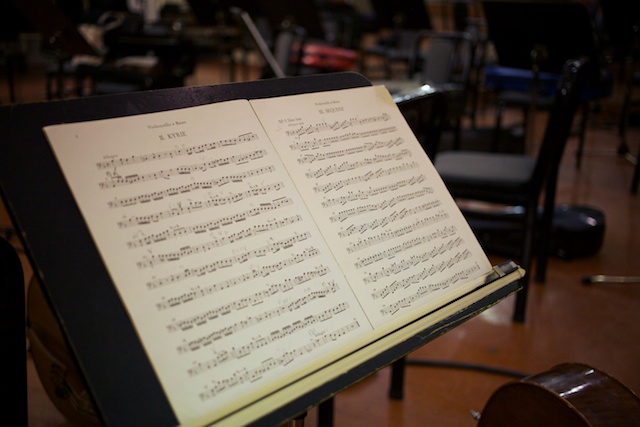
By @kixes, re-posted from #spuddings
The performance was short. Extracts from Mozart’s Requiem, voices interwoven with the melodies and harmonies from strings, brass and woodwinds. When it was over there was a short silence before the applause, and members of the chorus raised their arms with the ‘V’ sign. The applause went on and on, and one by one audience members stood up to give the ERT orchestra a standing ovation.
Considering that one of their last official concerts drew a crowd of 1,200, Tuesday night’s reception was a modest one. But the applause went on and on, a rhythmic clap as the orchestra stood for their bows and the conductor hugged the concert master.
After all, who knows how long more this orchestra can go on?
Truths and lies about ERT: A former news director answers the Prime Minister's claims
The lost signal of democracy
Yorgos Avgeropoulos (documentary filmmaker,
author & director of the Exandas Documentary Series) writes:
The unprecedented decision by the government to shut down ERT – the Greek Public Broadcaster has been a heavy blow for all. Both me and my colleagues, journalists and technicians, we ran immediately at the ERT Broadcasting Center. Since the beginning, every day we are recording what we see. We just edited quickly nine minutes to not erase from our memory what happened the first day. This is our way to react. We will continue as much as we can.
This is a rough cut sequence, part of the feature-length documentary that we are filming since the beginning of the crisis, for the last three years. It is called “AGORÁ - From Democracy to the Market” and it is an international co-production of major TV networks. AGORÁ will be released in April 2014.
Main Credits:
Written & Directed by Yorgos Avgeropoulos
Producers: Yorgos Avgeropoulos, Anastasia Skoubri
Picture: Yiannis Avgeropoulos, Anna Prokou
Music: Yiannis Paxevanis
Production Manager: Anastasia Skoubri
Editing: Anna Prokou, Vasilis Magos
Researchers: Georgia Anagnou, Ahilleas Kouremenos, Andreas Vagias
A Small Planet production © 2013-2014 smallplanet.gr
<<< Previous post: The Council of State ruling about ERT: what on earth does it mean?
Tuesday, 18 June 2013
The Council of State ruling about ERT: what on earth does it mean?
1. That enforcement of the common ministerial decision is suspended "exclusively with regard to those items pertaining to a) the interruption of transmissions of radio and television signals and of operations of websites owned by ERT, and b) the fact that ERT frequencies should remain inactive (article 2, § 2, item b of the common ministerial decision)."
2. That competent ministers [i.e. the Minister of Finance and the Minister of State responsible for media affairs] should take "necessary organizational measures for the resumption of radio and television signal transmissions and the operation of websites owned by a public broadcaster until the establishment of a new agency which will serve the public interest, as stipulated in article 1 § 2 of the common ministerial decision."
But what does this mean in practice?
Saturday, 15 June 2013
In focus: Why is the Greek government trying to shut down ERT? - The role of digital network provider DIGEA
On Tuesday 11 June 2013, the Greek government announced its decision to shut down the country's public broadcaster ERT and proceeded with taking all ERT television and radio channels off the air.
This came as a public consultation is under way to determine the terms under which a network provider will be selected to complete the country's transition to digital television.
Radiobubble interviewed on Friday 14 June 2013 ERT senior technician Nikos Michalitsis, whose analysis of the call for expressions of interest for digital network providers bears ominous signs for the future of press freedom in Greece. We are posting the interview below.
This came as a public consultation is under way to determine the terms under which a network provider will be selected to complete the country's transition to digital television.
Radiobubble interviewed on Friday 14 June 2013 ERT senior technician Nikos Michalitsis, whose analysis of the call for expressions of interest for digital network providers bears ominous signs for the future of press freedom in Greece. We are posting the interview below.
You can listen to this week's full #rbnews international show here.
<<< Previous post in this series: #rbnews international show 15 June 2013 - Why is the government shutting down ERT?
<<< Previous post in this series: #rbnews international show 15 June 2013 - Why is the government shutting down ERT?
#rbnews international show 15 June 2013 - Why is the government shutting down ERT?
You can follow Michael on Twitter @dialogosmedia.
And of course, you can listen to the podcast after the jump.
Friday, 14 June 2013
ERT shutdown - Live blog 14 June 2013
Here are a few useful tidbits of information to start the day:
- The EBU is still livestreaming ERT (watch here). It appears however that ERT radio and television is back on air on analog frequencies in some parts of the country. ERT World seems to be broadcasting normally abroad while ERT radio is broadcasting nationwide through Flash fm radio.
- The Hellenic Parliament reportedly came under attack from Anonymous last night. It is unclear yet what information exactly they gathered, but the cyber attack was apparently on an extremely large scale and included email correspondence of MPs.
- The Communist Party's television station 902, whose digital frequency has been going off air in the last few days, conducted some tests to determine if this was an accident or not, by broadcasting their regular programming and then switching to ERT live. Every time they did, the signal was thrown off air within seconds. In its statement, 902 denounces the government but also digital transmission service DIGEA, a private company which is enforcing the government's policy to silence anyone who broadcasts ERT.
- Protests against the shutdown of ERT are continuing in Greece and abroad; for example at least three rallies are planned in the UK today in London, Edinburgh and Bristol. Another one is planned in Sydney, Australia on Sunday.
- @plitharas compiled here a good sample of international media about the ERT shutdown.
We will be updating this post throughout the day.
Thursday, 13 June 2013
ERT shutdown - Round-up of developments 13 June 2013

Wednesday, 12 June 2013
The shutdown of ERT - Live blog 12 June 2013

A summary of key events yesterday (more here):
- The government issued in the morning an act of legislative content which enables ministers to shut down public agencies and sack their staff with a simple signature. Acts of legislative content are an emergency procedure that allows the government to enact legislation immediately and seek the approval of parliament within three-and-a-half months.
- The decision to shut down ERT and sack its ~2,700 staff was issued by 9 pm.
- Reaction was immediate from labour unions, opposition parties, international media watchdogs and the public at large. Rallies gathered outside ERT facilities across the country while ERT journalists took over the facilities and continued broadcasting.
- The two junior partners of the government coalition, PASOK and Democratic Left, have stated their opposition to the shutdown of ERT and announced that they will not approve the bill when it comes to parliament.
- The police was sent to take down ERT transmission facilities late at night. At this point, some other media are broadcasting ERT's signal, mostly online.
- A general media strike began this morning at 6 am for radio and television stations, with newspapers due to join tomorrow. Media who are broadcasting ERT's signal are exempt from the strike.
- The government announced this morning that a new public broadcaster, called NERIT (New Hellenic Radio, Internet and TV), will be established by 29 August and will operate with 1000 to 1200 employees. The bill to establish the new broadcaster can be found here.
- More rallies against the shutdown of ERT are planned today across the country.
Tuesday, 11 June 2013
Greece: The government wants to shut down public radio and television

Sackings on such a scale are unlikely to improve the situation of press freedom in Greece. Dimitris Trimis, the chairman of the Athens Daily Newspaper Editors' Union, told is last week on the #rbnews international show:
The thousands of sackings in media, the pay cuts, the fear that media will collapse and shut down, together with the parameter I just mentioned [the unhealthy links between media, big business and politics], creates a climate of violent censorship and self-censorship among people who work in the media. Therefore, we cannot talk of freedom of expression, and this is why international researchers keep demoting Greece in indexes where countries are ranked according to freedom of speech and objectivity, or at least honesty, in information.
Subscribe to:
Posts (Atom)